Key takeaways
- Salesforce CPQ has reached end of sale, not end of life: existing customers continue to receive support and critical fixes.
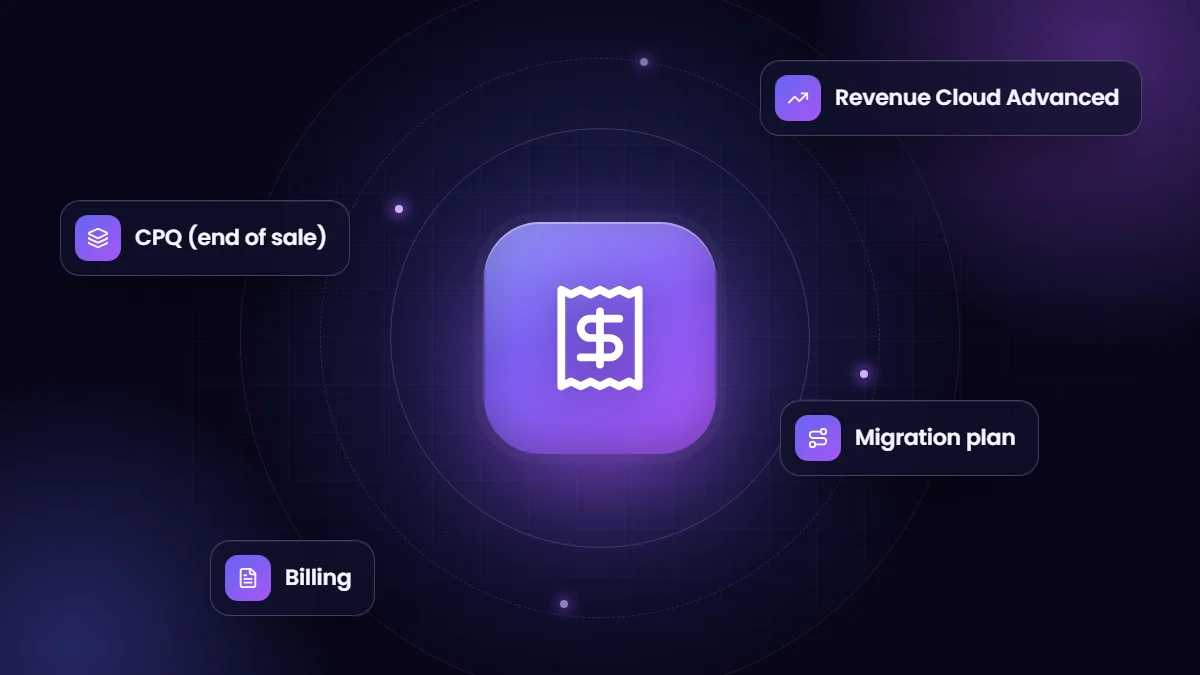
- Salesforce positions Revenue Cloud Advanced, within its Agentforce Revenue Management suite, as CPQ’s successor, with Revenue Cloud Billing for invoicing.
- Salesforce states there is no forced migration, so existing CPQ customers can plan on their own timeline.
- Migration is typically a re-implementation rather than an upgrade, so treat it as a chance to simplify pricing and quoting.
For years, Salesforce CPQ, originally Steelbrick, was the default answer for configure-price-quote on Salesforce. Salesforce has since stopped selling it to new customers and moved product investment to Revenue Cloud. If your sales team quotes in CPQ, here is what that means.
End of sale versus end of life
End of sale means new customers can no longer buy CPQ. Salesforce states that existing customers keep their access, can renew, and continue to receive support and critical fixes, while new feature development goes to Revenue Cloud. It is not an end-of-life announcement with a shutdown date.
What replaces it
| Product | Role |
|---|---|
| Revenue Cloud Advanced | Configuration, pricing, quoting, contracting and renewals, built API-first on the core platform |
| Revenue Cloud Billing | Usage rating, invoicing and collections, often paired with Revenue Cloud Advanced |
| Agentforce Revenue Management | Salesforce’s suite branding for its revenue products |
Options for existing CPQ customers
- Stay on CPQ for now. If CPQ works and your needs are stable, continuing is reasonable while you plan.
- Simplify in place. Remove unused rules, products and templates to reduce maintenance and ease any future move.
- Plan a move to Revenue Cloud. Especially if you need capabilities CPQ lacks or are rethinking pricing.
- Evaluate alternatives. Other quoting tools on AppExchange, or lighter custom quoting, may suit simpler needs.
Planning a migration
- Inventory products, bundles, price rules, discount schedules, templates and approvals.
- Identify what is actually used; quoting configurations often accumulate years of unused complexity.
- Redesign pricing and approvals for today’s business, not yesterday’s.
- Plan data migration for active quotes, contracts, subscriptions and assets.
- Run old and new processes in parallel for a pilot team before switching.
When a full CPQ is more than you need
Many companies bought CPQ for capabilities they never used. If your products are simple and approvals are straightforward, standard Salesforce quotes, flows for approvals and a document generation tool may be enough, at far lower cost and complexity.
Product names, packaging and support terms come from Salesforce’s public materials at the time of writing. Confirm details for your contract with Salesforce.
We help clients assess quoting needs and plan CPQ simplification or migration; see our consulting services.
Simplification checklist for CPQ orgs
- Report which products, bundles and options were quoted in the last year.
- List price rules and product rules, and mark those never triggered.
- Review quote templates and retire unused ones.
- Document approval rules and who still relies on them.
- Archive or deactivate unused items in a sandbox first, then production.
Whether you stay on CPQ or migrate later, a simpler configuration is cheaper to maintain and far easier to move.
Frequently asked questions
Will Salesforce CPQ stop working?
Salesforce describes CPQ as end of sale, not end of life, with continued support and critical fixes for existing customers.
Is there an automatic upgrade from CPQ to Revenue Cloud?
Migration generally involves re-implementing quoting and pricing on the new product, along with data migration.
Do we have to migrate now?
Salesforce states there is no forced migration. Plan based on your needs, contract timing and the capabilities you require.