Key takeaways
- Buy when your processes are similar to most companies in your industry. Build when the process itself is your competitive advantage.
- Compare total cost over five years, including licenses, implementation, support, hosting and change requests.
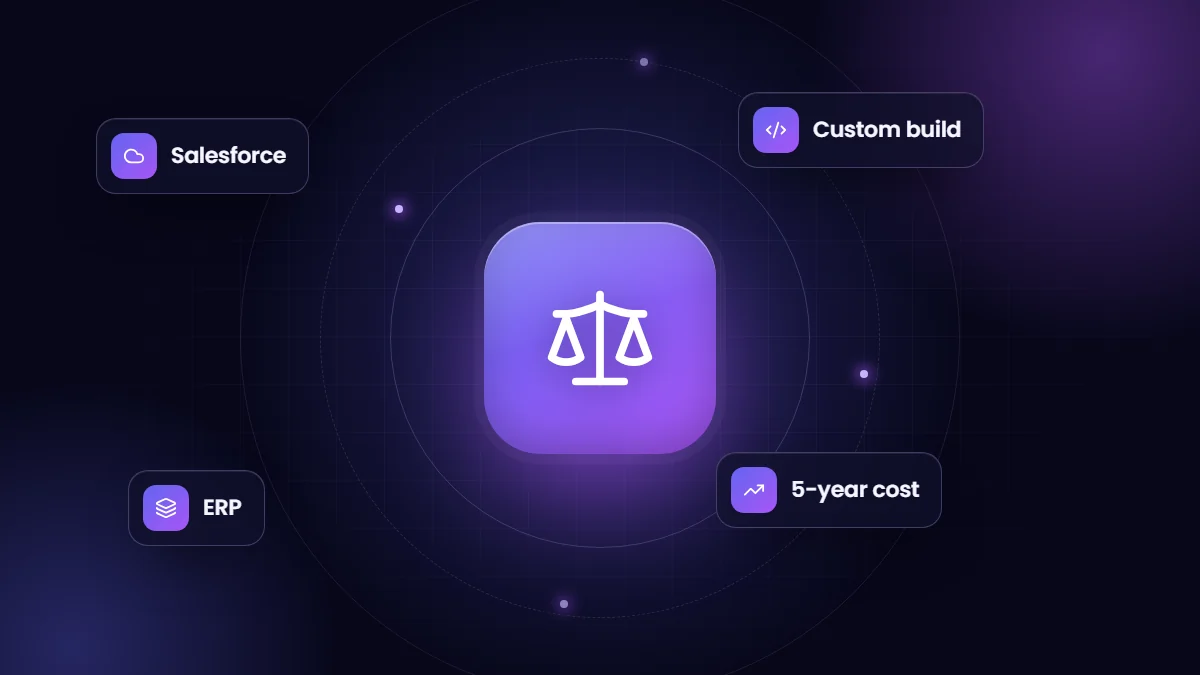
- Salesforce wins on ecosystem, security and speed for standard CRM. Custom software wins on fit, ownership and per-user economics at scale.
- Many businesses combine both: Salesforce for customer-facing work and a custom or specialized system for operations.
We build on Salesforce and we build custom software, so we have no reason to push one answer. Both are right in different situations, and choosing badly is expensive either way: a custom system that reinvents standard CRM features, or a Salesforce org bent so far out of shape that every release becomes a project.
When Salesforce is the better choice
- Your sales, service and marketing processes are broadly similar to other companies in your industry.
- You need to move quickly and benefit from a mature platform with mobile apps, reporting, security and automation built in.
- You want access to the AppExchange and a large pool of administrators and developers.
- You plan to use Salesforce’s AI capabilities, such as Agentforce, on your customer data.
- You prefer predictable subscription costs over owning and hosting software.
When custom software makes more sense
- The process is unusual and central to how you compete, and forcing it into a standard product would slow you down.
- You have many users who need simple, narrow functionality, where per-user licensing becomes expensive.
- You need offline-first operation, specialized hardware integration or a data model no CRM supports well.
- You want to own the code and data model outright, or productize the system for others.
Compare the five-year cost, not the first-year price
| Cost | Salesforce | Custom build |
|---|---|---|
| Licenses or subscriptions | Per user per month, rising with users and editions | None, or open-source components |
| Initial implementation | Configuration, customization and data migration | Design, development, testing and migration, usually higher |
| Hosting and infrastructure | Included | Cloud hosting, monitoring and backups |
| Ongoing changes | Admin and developer time | Developer time for every change |
| Upgrades and security | Three automatic releases a year, managed by Salesforce | Your responsibility |
For a team of 20 users on a standard CRM, Salesforce usually wins comfortably. For hundreds of users doing narrow tasks, or for operations that look nothing like CRM, a custom system can cost less over time and fit far better.
ERP is a different question
Salesforce is a CRM platform, not an ERP. Inventory, purchasing, manufacturing and accounting are usually better served by an ERP, either an established product or a custom or configurable platform, integrated with Salesforce for the customer-facing side. The important decision is which system owns which data, and how the two stay in sync.
The hybrid approach
Many of the most effective setups we see combine both: Salesforce for sales, service and customer communication, and a specialized or custom system for operations, connected by a well-designed integration. Each system does what it is best at, and neither is bent out of shape.
Questions to settle before deciding
- Which processes are standard in our industry, and which genuinely differentiate us?
- How many users will we have in three years, and what will each of them need?
- Who will own and maintain the system after launch?
- What is the cost of being wrong, and how easily could we change course?
If you are weighing a configurable ERP alongside or instead of Salesforce, our Business ERP and CRM platform and custom software development pages explain how we approach those projects.
Frequently asked questions
Is building a custom CRM cheaper than Salesforce?
Sometimes, over the long term and at large user counts. For most small and mid-size teams with standard needs, Salesforce is cheaper and faster once development and maintenance are counted.
Can Salesforce work as an ERP?
Salesforce can handle some operational processes, and there are ERP products built on the platform, but core accounting and inventory are usually best handled in an ERP integrated with Salesforce.
Can we start on Salesforce and move later?
Yes. Salesforce data can be exported, and clean data models and documented processes make any later move much easier.