Key takeaways
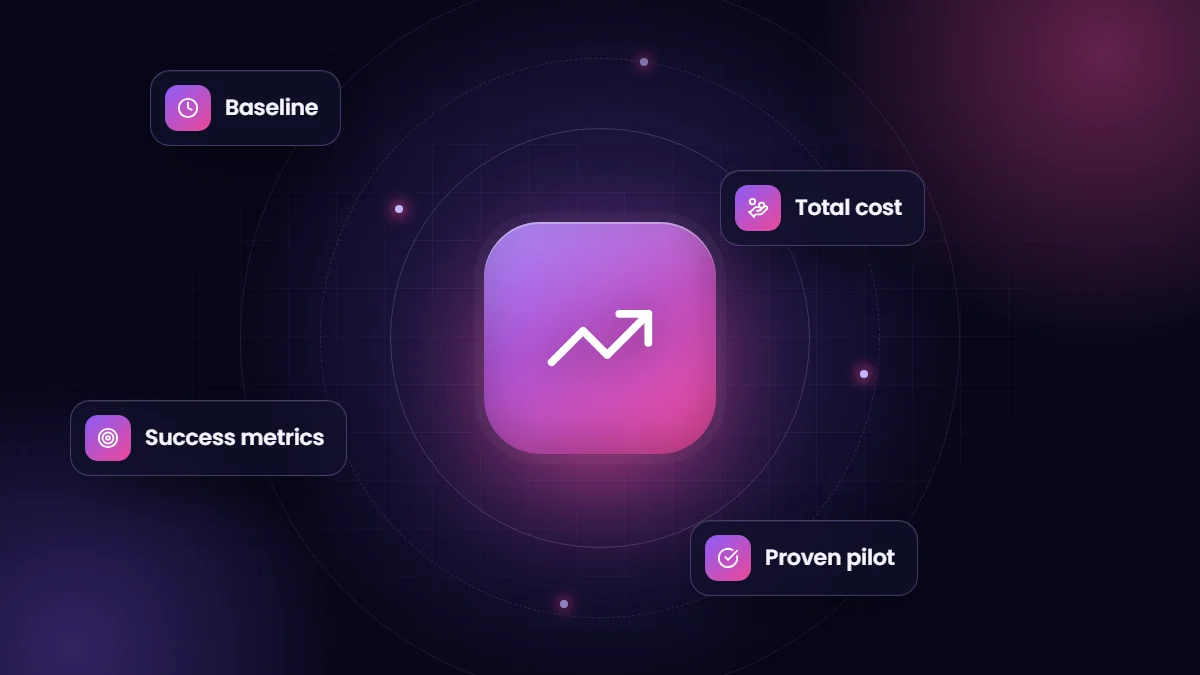
- Start with a measured baseline of the current process: volume, time per task, error rates and cost.
- Estimate realistic gains, not best-case demos, and include human review time.
- Count all costs: build, AI usage, integrations, change management and ongoing tuning.
- Define pilot success metrics in advance, so the decision to scale is based on evidence.
Many AI initiatives start with a demo and end with a pilot that nobody can justify scaling. The missing piece is usually a clear business case. Estimating return on investment before building does not need complex finance; it needs honest numbers about the process you want to improve.
Step 1: baseline the process
| Measure | Example |
|---|---|
| Volume | 2,000 support emails a month |
| Time per item | 6 minutes average handling time |
| Cost per hour | Fully loaded cost of the staff involved |
| Quality | Error or rework rate, response time, customer satisfaction |
Measure rather than guess where possible. A week of tracking often reveals that the real bottleneck is different from the assumed one.
Step 2: estimate realistic gains
- Time saved: what share of items can AI fully handle, and how much faster are the rest with AI assistance?
- Quality: fewer errors, faster responses, more consistent outputs.
- Revenue: faster lead response or more capacity for sales and service.
- Review time: subtract the time people spend checking AI output.
Step 3: count all the costs
- Design and build, including integrations with your systems.
- AI platform or model usage, which often scales with volume.
- Data preparation, such as cleaning knowledge or documents.
- Change management and training.
- Ongoing monitoring, tuning and support.
A simple worked example
Suppose a team handles 2,000 routine requests a month at 6 minutes each, which is 200 hours. If AI fully resolves 40% and halves the time on the rest, the team saves roughly 80 hours on resolved items and 60 hours on assisted ones, about 140 hours a month. Multiply by the hourly cost and compare with monthly platform and support costs plus the build cost spread over a sensible period. If the numbers only work under perfect assumptions, the use case is probably not the right first project.
The figures in this example are illustrative. Use your own measured volumes and costs.
Step 4: design the pilot to prove it
- Agree success metrics before starting, such as resolution rate, time saved, accuracy and satisfaction.
- Run the pilot on real work with a defined group and timeframe.
- Compare against the baseline, including the cost of review.
- Decide in advance what result justifies scaling.
Choosing the right first project
The best first AI projects combine high volume, clear rules, measurable outcomes and low risk if something goes wrong. Internal assistance, such as drafting replies or extracting data for review, often proves value faster than fully autonomous customer-facing automation.
Our AI solutions work starts with this kind of business case, so projects are chosen for value, not novelty.
Metrics by use case
| Use case | Primary metrics |
|---|---|
| Customer service agent | Resolution rate, CSAT, handle time saved |
| Document extraction | Accuracy per field, documents processed per hour, error rate |
| Sales assistance | Speed to lead, meetings booked, rep time saved |
| Internal knowledge assistant | Answer accuracy, questions answered, time to answer |
Red flags in AI business cases
- Benefits based on a demo rather than measured work.
- No allowance for review time or exceptions.
- AI usage costs estimated at today’s volumes only.
- No owner for the process after launch.
- Success defined vaguely, such as “improve productivity”.
Frequently asked questions
How long until an AI project pays back?
It depends on volume and costs. Well-chosen projects in high-volume processes often show measurable savings within months of going live.
What if the benefits are mainly quality, not time?
Quantify quality where possible, for example fewer refunds, faster response times or higher conversion, and include it in the case.
Should we build or buy AI tools?
Buy when a product fits your process well; build when the process is specific or the integration is the hard part. The ROI method is the same either way.