Key takeaways
- Kipu is a widely used EMR for addiction treatment and behavioral health; many providers run admissions and marketing in a CRM such as Salesforce.
- Integration avoids re-keying patients at admission and gives admissions and marketing teams visibility of census and outcomes.
- Kipu provides API access to its clients and developers working with them through an API key, so involve Kipu early.
- Design for HIPAA and 42 CFR Part 2: minimum necessary data, consent and strict access control.
Behavioral health and addiction treatment providers often use Kipu as their electronic medical record while running admissions, referral management and marketing in Salesforce. Without integration, admissions staff re-type patient details at admission, and marketing cannot see which inquiries became admissions. Connecting the two closes that loop.
Who does what
| System | Typical role |
|---|---|
| Salesforce | Inquiries, admissions pipeline, insurance verification tracking, referral sources, marketing attribution |
| Kipu | Clinical record, treatment, census, documentation and billing-related workflows |
Kipu also offers its own CRM capabilities; organizations that choose Salesforce usually do so for deeper customization, broader marketing and reporting needs, or because Salesforce is already used across the organization.
What to sync
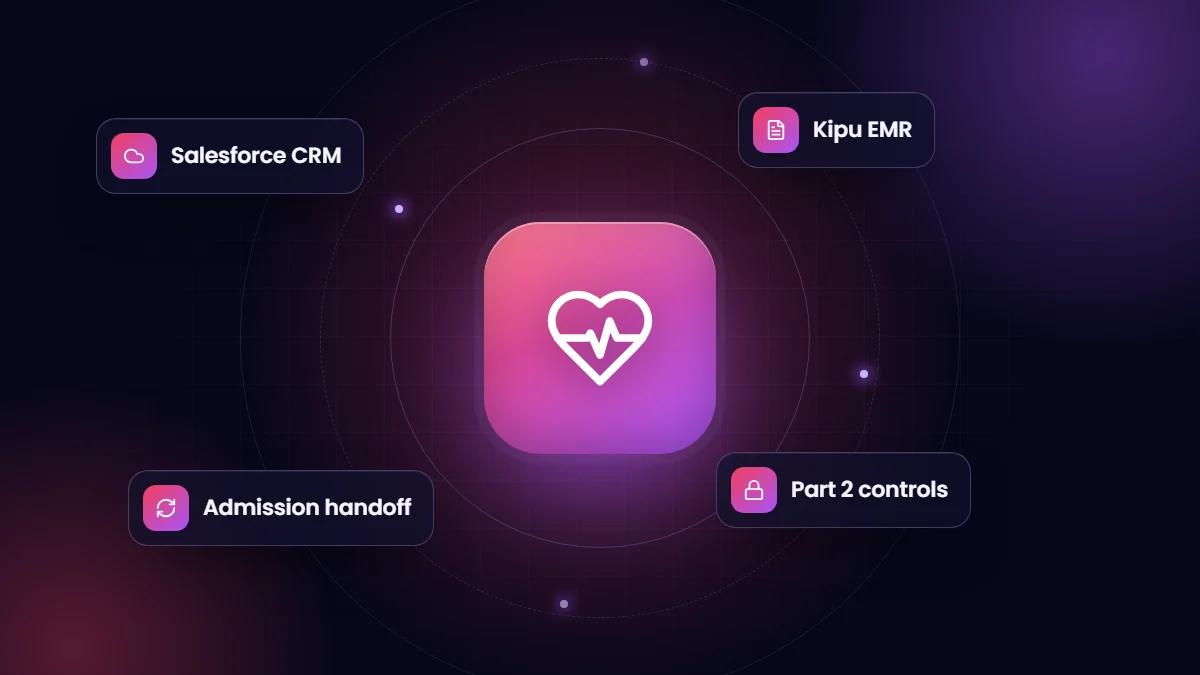
- Admission handoff: when an inquiry becomes an admission in Salesforce, create or match the patient in Kipu with the agreed demographic and insurance details.
- Status back to Salesforce: admission date, level of care, discharge date and status, so admissions and marketing teams see outcomes.
- Referral attribution: link admissions and outcomes to referral sources and campaigns, within privacy rules.
- Census visibility: current capacity by program or facility to guide admissions conversations.
Integration approaches
- Kipu API: Kipu provides API access for its clients and developers working with them, using an API key. Confirm available endpoints, data and terms with Kipu for your use case.
- Middleware: an integration platform or custom service that handles matching, transformation, logging and retries between Kipu and Salesforce.
- Scheduled exports: where real-time sync is not needed, scheduled data exchange can be simpler.
Privacy and compliance
- Both systems and any middleware must be covered by business associate agreements.
- Sync only the minimum necessary data; clinical detail usually stays in Kipu.
- Substance use disorder records may be subject to 42 CFR Part 2, whose updated rule required compliance by February 16, 2026; design consent and redisclosure controls with counsel.
- Restrict access in Salesforce so marketing users see outcomes and attribution without clinical details.
- Log all data exchanges for audit.
Implementation steps
- Agree with Kipu and your compliance team which data may flow in each direction.
- Define patient matching rules to avoid duplicates.
- Build and test in non-production environments with test data.
- Run a pilot with one facility or program.
- Monitor sync errors daily during the first weeks.
We build admissions CRMs and EMR integrations for behavioral health providers; see our industry solutions.
Matching patients safely
Patient matching between the CRM and EMR must avoid both duplicates and, worse, merging different people. Use a combination of identifiers such as date of birth, name and phone number, prefer explicit IDs once a patient exists in both systems, and route uncertain matches to a person. Store each system’s ID on the other system’s record after the first successful match.
Reporting that admissions and marketing value
- Inquiries to admissions by referral source and campaign.
- Time from first contact to admission.
- Admissions by program, payer and facility.
- Average length of stay and outcomes, shared within privacy rules.
Frequently asked questions
Does Kipu have an API?
Kipu provides API access to its clients and developers working with them, using an API key. Confirm details and terms with Kipu.
Should clinical data sync into Salesforce?
Usually only the minimum needed for admissions and reporting. Clinical documentation generally stays in the EMR.
Can marketing see which campaigns lead to admissions?
Yes, with outcome data synced back and access designed so marketing sees attribution without clinical details.